INTERVIEW:
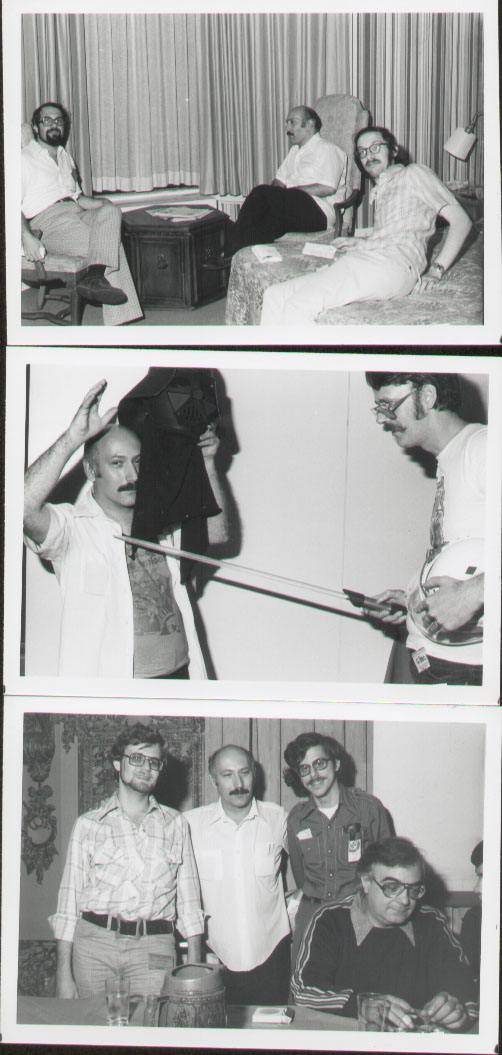
"An Interview with Gil Kane [April 6, 1926-January 31, 2000]" conducted by Gary Groth at Boston Newcon (October 20-22, 1976) and New York Creation Con (November 19, 1976). Transcribed by Mr. Groth, and edited by the same, with Mr. Thompson and Gil Kane.
[I don't believe this conversation has been reprinted in that Hermes Press book of Gil Kane interviews, so here's a paraphrasing of topics covered in this interview: The failure of HIS NAME IS SAVAGE and Adventure House; HIS NAME IS SAVAGE connection to "Conan" and Glenn Lord; Distribution and success (and failure) in the comics industry; Martin Goodman and Atlas/Seaboard; DC Comics and lack of a creative editorial viewpoint; "Comics is an incestuous business;" Adult comics content; Comics fanzines (John Benson mentioned) and fans at conventions; Influences: "Scorchy Smith" by Noel Sickles and "Tarzan" ("The Egyptian Period") by Hal Foster; Storytelling in comics; What he would do in comics if no commercial, content, or format restrictions; Jean Giraud (Moebius) comic artist he says is the "best comic strip artist going now;" Films and critical standards for evaluating comics; STAR HAWKS and Ron Goulart; EXCALIBUR book with John Jakes; Comics don't create they duplicate success until the characters are exhausted creatively; Views on: Harvey Kurtzman, Bernie Wrightson, Jim Steranko, Barry Windsor-Smith, Frank Frazetta, Jenette Kahn, Jack Kirby, Roy Thomas, Alex Nino, Ross Andru, Robert Kanigher, Neal Adams, Mike Golden, and others; Comics and content vs. format; and, more on films and parallels with comics.]
FANDOM REVIEW:
"Hogarth & CRIMMERS: An Excercise in Academic Futility" (pages 47-48) by Paul Dushkind [Mr. Dushkind takes over the "Fandom Review" column from early JOURNAL contributor Doug Fratz, who went on to edit the science-fiction magazine THRUST/QUANTUM. The following issue (#39 April 1978) the column passes on to Marilyn Bethke and her series of critiques of the JOURNAL'S comics press contemporaries!]
SCIENCE FICTION ANTHOLOGY:
"Growing Up Weird" (pages 49-50 55) by Mel Gilden. Ron Wilber: "Captain Video" illustration [I'm considering this the second (and last?) in a series of unpublished articles from Frank Catalano's defunct SIRIUS XIV science-fiction newsletter although I could be mistaken, the first (appearing in the previous issue of the JOURNAL) was "You, too, need protein for a smoother glissando (Or, food for thought)" by Greg Bear. This essay is a well-done slice-of-life done from the viewpoint of a science-fiction author growing up on science-fiction books and telelvision, and pondering how these inspired his writing career and life in general.]
REVIEW:
"The Kingdom and the Power of Jack Katz" (pages 51-52 54-55) by Bill Sherman [Mr. Sherman reviews the first six volumes, focusing somewhat on volumes 5 and 6, of Jack Katz's self-published THE FIRST KINGDOM, an anomaly in the 70s outside of the underground comix and far to individualistic to be considered mainstream.] [Preview page from the then upcoming THE FIRST KINGDOM Volume 7 on page 54]
PRIME-TIME SUPERHEROES:
"Greenskin, Webhead, and the Boob Tube" (pages 56-57) by Kim Thompson. Bob Aull: illustration [This was a bit of a surprise, a review of the pilots of the "Amazing Spider-Man" and "The Hulk." Since Mr. Thompson is now bringing us those amazing Tardi translations, I think I'll refrain from quoting any passages from this one!]
sidebar: "News Update: Marvel TV Movies" [Stan Lee said these movies were in development Human Torch, Captain America (released in 1979), Howard the Duck (released in 1986), Ms. Marvel, Dr. Strange (released in 1978), and Sub-Mariner. Also mentions Marvel considering buying their own animation studio, which I seem to recall them eventually accomplishing in the 1980s.]
ANIMATION:
"Allegro Non Troppo: Fantasia With a Vengeance" (pages 58-59) by Gary Groth [review of Bruno Bozzetto's animated movie, particularly the sequence adapting Ravel's "Bolero" which can be viewed below.]
part 1
part 2
via
"The Hobbit: A Rich and Colorful TV Adaptation" (pages 59 62) by Steve Clement (1953-1981)
sidebar: "Doonesbury" [a review of two animated television releases from 1977, the latter titled fully: "A Doonesbury Special."]
THE CREATIVE EXPERIENCE:
"The Outer Limits of the Imagination" (pages 60-61) by Jim Wilson. Judy (Judith) Hunt: illustration. [a review by then-television-producer Wilson of Ted C. Rypel's THE OUTER LIMITS: AN ILLUSTRATED REVIEW Volumes 1 and 2. I believe this is Mr. Wilson's last column for the JOURNAL as he does not contribute to the next issue, he was a contributor beginning with THE NOSTALGIA JOURNAL 27, the first Fantagraphics issue.]
COMIC STRIPS:
"Howard the Duck" (pages 63-66) by Steve Gerber and Gene Colan. [Three Sunday pages of the short-lived comic strip incarnation reprinted in black and white. 7/3, 7/10, and 7/17 with the first being printed twice just because it's TCJ!] [link via Journalista]
BACK COVER:
montage of ASTERIX, "Close Encounters," STAR HAWKS, and an original illustration by Joe Sinardi.
ADVERTISEMENTS:
(page 2) OMNIVERSE 1, Fall 1977, Mark Gruenwald/Dean Mullaney editors [Pete Poplaski cover, reprinted along with ad]
(page 3) subscription ad
(page 4) ROCKET'S BLAST COMICOLLECTOR 139, James Van Hise editor [Star Wars-themed issue. contributors: Ralph Fowler, Morris Scott Dollens, Steven Fabian, Kerry Gammill, Ron Wilber, Don Rosa.]
(page 6) Greg Tuliebitz sale list
(page 11) READER WRITTEN COMICS 2 [contributors: Steve Vance, Max Giguere, Dave Sim, Bill Kent Jr., and Bruce Shane.]
(page 12) 1977 Comic Art Fan Awards - Nominating Ballot [administered by Don Fortier]
(pages 16-17) Monkey's Retreat/Well News Service ad
(page 19) OUTER LIMITS NEWSLETTER, Steve Streeter editor
(page 23) Abel Mills 35mm film clips sale
(page 24) Pikes Peak Book Exchange, SCAN magazine ad
(page 31) Bud Plant ad [ASTERIX]
(page 32) Camelot of Houston, TX ad [THE GOLDEN AGE OF TARZAN 1939-1942 by Burne Hogarth.]
(page 33) Camelot of Houston, TX ad [this page has a "Drake Vader" t-shirt design by Newsome advertised.]
(page 46) 1978 COLLECTORS SHOWCASE auction catalog ad [painted cover reproductions by: Alex Schomburg; Sheldon Moldoff; Fred Ray; Dan Zolnerowich; Alfred Avison; Dick Briefer; Creig Flessel; C.C. Beck; John Celardo; Mike Sekowsky; Alex Kotsky; Paul Reinman; and, Bill Ward. Wow, here's what your favorite golden-age comic book artists were doing in 1978!]
(page 50) MR. KISS KISS BANG BANG 2, Mike France editor [James Bond movie fanzine]
(page 53) Bud Plant ad [FIRST KINGDOM]
(page 55) Sanford L. Jones E.C. Comics sale list
(page 57) BIZARRE THRILLS 1, Bill Black editor [High quality early Bill Black publication (still in print digitally). contributors: R.C. Harvey, Marc Hempel, Tom Lyle, Clifford Neal, Bill Pearson, Joe Staton, Steve Vance (he gets around), and Wallace Wood. partial cover illustration of "Phantom Lady" by Joe Staton and Mr. Black reproduced with the ad.]
(page 62) classified ads from: CEG, Star Gallery, Ernest Whitaker, Stan Timmons, Ward O. Batty, Dwight Decker, Charles Lawrence, Old Radio Warehouse, Howard Rogofsky, Larry Collier, Peter Crosby, Fry's, Christian Haerle, Mark E. Ernst, Harland Ronning, Clifford Meth, Chris Lareau, Bill-Dale Marcinko, and Masthead: AJFTHWON.
(page 67) Bill Cole ad
AFTERWORD:
Coming to a final top ten out of 274 issues of THE NOSTALGIA/COMICS JOURNAL without going crazy required dividing up the long run into rough periods and special issues. The first period (or "era," if you want to get pretentious) I label the "pre-lawsuit" halcyon days which ran from 27-52. While there were many individual highlights among these efforts (discounting all the tabloid issues which I've never seen), I picked #38 for the exhaustive Dwight Decker article on "Asterix" (which still stands up today as a history of the early years of the series) and Gary Groth's interview with Gil Kane which stretched the boundaries of comics journalism in touching on the artist's life and interests outside of comics rather than the worlds on paper he created (that some comic fans mistake for "real" life). There are also some quality shorter pieces like Bill Sherman's analysis of the early issues of THE FIRST KINGDOM, an unjustly forgotten pioneering work. Having reviews by both Mr. Groth and Mr. Thompson in the same issue would seem to push this one over the top, however I'll just say they got a lot better material to analyze in future issues. -GU
THE COMICS JOURNAL (c)2010 Fantagraphics Books, Inc.
Thursday, January 28, 2010


Sunday, January 17, 2010
Top 10 Issues of The Comics Journal: #38 Part Two
STATEMENT OF OWNERSHIP (page 13):
Here are some numbers that reflect the circulation of the tabloid-version of THE COMICS JOURNAL, contrast these with the statement on the contents page (page 5) of "Paid Circulation: 9,000" for the magazine-version.
"Statement of Ownership, Management and Circulation (required by 39 U.S.C. 3685)
1. Title of publication: THE COMICS JOURNAL
2. Date of filing: 1 Oct. 1977
3. Frequency of issue: BI-MONTHLY
A. No. of issues published annually: 6
B. Annual subscription price: $1.80
4. Location of known office of publication: 9308 CHERRY HILL ROAD, COLLEGE PARK, MD 20740
5. Location of the headquarters or general offices of the publishers: SAME
6. Names and addresses of publisher, editor, and managing editor:
Publisher: FANTAGRAPHICS, INC., 9308 CHERRY HILL ROAD, COLLEGE PARK, MD 20740. Editor: GARY G. GROTH, SAME
Managing editor: J. MICHAEL CATRON, SAME
7. Owner (If owned by a corporation, it's name and address must be stated and also immediately thereunder, the names and addresses of stockholders owning or holding 1 percent or more of total amount of stock. If not owned by a corporation, the names and addresses of the individual owners must be given. If owned by a partnership or other unicorporated firm, its name and address, as well as that of each individual must be given.): FANTAGRAPHICS, INC., CHERRY HILL ROAD, COLLEGE PARK, MD 20740
1) GARY G. GROTH, SAME
2) J. MICHAEL CATRON, SAME
8. Known bondholders, mortgages, and other security holders owning or holding 1 percent or more of the total amount of bonds, mortgages or other securities (If there are none, so state): NONE
9. [...]
10. Extent and nature of circulation:
A. Total no. copies printed (net press run):
Average no. copies each issue during preceding 12 months: 3, 157
Actual no. copies of single issue published nearest to filing date: 3,500
B. Paid circulation:
1. Sales through dealers and carriers, street vendors and counter sales:
Average no. copies during preceding 12 months: 125
Actual no. copies of single issue published nearest to filing date: 500
2. Mail Subscriptions:
Average no. copies during preceding 12 months: 2, 632
Actual no. copies of single issue published nearest to filing date: 2, 682
C. Total paid circulation (sum of 10B1 and 10B2):
Average no. copies each issue during preceding 12 months: 2,757
Actual no. copies of single issue published nearest to filing date: 3,182
[D.]Free distribution by mail, carrier or other means. Samples, complimentary, and other free copies:
Average no. copies each issue during preceding 12 months: 206
Actual no. copies of single issue published nearest to filing date: 268
E. Total distribution (sum of C and D):
Average no. copies each issue during the preceding 12 months: 2,963
Actual no. copies of single issue published nearest to filing date: 3,450
F. Copies not distributed:
1. Office use, left over, unaccounted, spoiled after printing:
Average no. copies each issue during the preceding 12 months: 194
Actual no. copies of single issue published nearest to filing date: 50
2. Returns from news agents:
Average no. copies each issue during the preceding 12 months: ----
Actual no. copies of single issue published nearest to filing date: ----
G. Total (Sum of E, F1 and 2 should equal net press run shown in A):
Average no. copies each issue during the preceding 12 months: 3,157
Actual no. copies of single issue published nearest to filing date: 3,500
11. [...]
12. [...]"
COMICS REVIEWS (page 14-15 18-19):
-"Steel and Fire from Conway" (page 14-15) by Gene Phillips [STEEL 1 and FIRESTORM 1 by Gerry Conway] This was Mr. Phillips second review for the JOURNAL, he had previously reviewed THOR in #35. (source Peter Coogan)
-"Women's Lib and DC" (page 15) by Marilyn Jo Bethke [SHOWCASE 97 (Power Girl)] This was Marilyn Bethke's first contribution to the JOURNAL, she became a powerful voice in future issues especially valuable (in my opinion, at least) as an interviewer (Joe Staton: #45 and Howard Chaykin: #51, off the top of my head). This review is fairly conservative with some perceptive analysis of the incompatibility of the Joe Staton and Joe Orlando art team. Although she does get in a nice paragraph in the middle of the review, on feminism: "Power Girl's statements reek of token feminism, stereotyped 'women's lib' behavior, which has nothing to do with real sexism, feminism, or liberation. The condescension of 'Come to Momma' on page two and the reverse sexism of 'You men -- always making problems...' on page six are examples of a particularly disgusting new women's stereotype, the 'libber.' Such distortion of feminism and its issues does nothing more than hurt all feminists, women and men, and turn women's (and men's) liberation from a serious, important, and complex issue into an over-simplified cliche.[...]" (page 15, column two) (excerpt (c)2009 Marilyn Bethke)
-"The Schlumps and the Spacecraft: A Grouse at Close Encounters" (pages 18-19) by Dennis O'Neil [review of CLOSE ENCOUNTERS OF THE THIRD KIND by the comics writer and editor]
FEATURE:
"Asterix: 'These Frenchmen Are Crazy!'" (pages 20-22 25-30) by Dwight R. Decker
I. "These Gauls are Crazy"
[Introduction to the basics of the ASTERIX album series and it's two main characters.]
II. Background
[Historical perspective on Rene Goscinny and Albert Uderzo's work before ASTERIX, the early days of ASTERIX in "Pilote" magazine, and it's place among then contemporary French comics.]
III. The Creators
[Short biographies of Rene Goscinny and Albert Uderzo]
IV. The World of Asterix
[The intersections of ASTERIX'S fictional world and historical France.]
V. The Players
[Character descriptions of Asterix, Obelix, Dogmatix, Getafix, Cacophonix, and Vitalstatistix.]
VI. How to Read Asterix
[A reader's guide on where to start reading this (even 32 years ago!) long-running series.]
VII. Critique
[Mr. Decker goes over a few weaknesses of the ASTERIX series.]
sidebar 1: ASTERIX FILMOGRAPHY
"Asterix the Gaul" (1968)
via
"Asterix and Cleopatra" (1970)
via
"The Twelve Tasks of Asterix" (1976)
via
sidebar 2: ASTERIX CHECKLIST [link to gallery of all english editions of ASTERIX, click on "Universalis" and choose English]
sidebar 3: Don Rosa: illustration [Tribute to Rene Goscinny (1926-77) upon his death, featuring all the major ASTERIX characters]
THE COMICS JOURNAL (c)2009 Fantagraphics Books Inc.
Our examination of THE COMICS JOURNAL #38 concludes next time (thrill to Gary Groth's review of ALLEGRO NON TROPPO)...
Here are some numbers that reflect the circulation of the tabloid-version of THE COMICS JOURNAL, contrast these with the statement on the contents page (page 5) of "Paid Circulation: 9,000" for the magazine-version.
"Statement of Ownership, Management and Circulation (required by 39 U.S.C. 3685)
1. Title of publication: THE COMICS JOURNAL
2. Date of filing: 1 Oct. 1977
3. Frequency of issue: BI-MONTHLY
A. No. of issues published annually: 6
B. Annual subscription price: $1.80
4. Location of known office of publication: 9308 CHERRY HILL ROAD, COLLEGE PARK, MD 20740
5. Location of the headquarters or general offices of the publishers: SAME
6. Names and addresses of publisher, editor, and managing editor:
Publisher: FANTAGRAPHICS, INC., 9308 CHERRY HILL ROAD, COLLEGE PARK, MD 20740. Editor: GARY G. GROTH, SAME
Managing editor: J. MICHAEL CATRON, SAME
7. Owner (If owned by a corporation, it's name and address must be stated and also immediately thereunder, the names and addresses of stockholders owning or holding 1 percent or more of total amount of stock. If not owned by a corporation, the names and addresses of the individual owners must be given. If owned by a partnership or other unicorporated firm, its name and address, as well as that of each individual must be given.): FANTAGRAPHICS, INC., CHERRY HILL ROAD, COLLEGE PARK, MD 20740
1) GARY G. GROTH, SAME
2) J. MICHAEL CATRON, SAME
8. Known bondholders, mortgages, and other security holders owning or holding 1 percent or more of the total amount of bonds, mortgages or other securities (If there are none, so state): NONE
9. [...]
10. Extent and nature of circulation:
A. Total no. copies printed (net press run):
Average no. copies each issue during preceding 12 months: 3, 157
Actual no. copies of single issue published nearest to filing date: 3,500
B. Paid circulation:
1. Sales through dealers and carriers, street vendors and counter sales:
Average no. copies during preceding 12 months: 125
Actual no. copies of single issue published nearest to filing date: 500
2. Mail Subscriptions:
Average no. copies during preceding 12 months: 2, 632
Actual no. copies of single issue published nearest to filing date: 2, 682
C. Total paid circulation (sum of 10B1 and 10B2):
Average no. copies each issue during preceding 12 months: 2,757
Actual no. copies of single issue published nearest to filing date: 3,182
[D.]Free distribution by mail, carrier or other means. Samples, complimentary, and other free copies:
Average no. copies each issue during preceding 12 months: 206
Actual no. copies of single issue published nearest to filing date: 268
E. Total distribution (sum of C and D):
Average no. copies each issue during the preceding 12 months: 2,963
Actual no. copies of single issue published nearest to filing date: 3,450
F. Copies not distributed:
1. Office use, left over, unaccounted, spoiled after printing:
Average no. copies each issue during the preceding 12 months: 194
Actual no. copies of single issue published nearest to filing date: 50
2. Returns from news agents:
Average no. copies each issue during the preceding 12 months: ----
Actual no. copies of single issue published nearest to filing date: ----
G. Total (Sum of E, F1 and 2 should equal net press run shown in A):
Average no. copies each issue during the preceding 12 months: 3,157
Actual no. copies of single issue published nearest to filing date: 3,500
11. [...]
12. [...]"
COMICS REVIEWS (page 14-15 18-19):
-"Steel and Fire from Conway" (page 14-15) by Gene Phillips [STEEL 1 and FIRESTORM 1 by Gerry Conway] This was Mr. Phillips second review for the JOURNAL, he had previously reviewed THOR in #35. (source Peter Coogan)
-"Women's Lib and DC" (page 15) by Marilyn Jo Bethke [SHOWCASE 97 (Power Girl)] This was Marilyn Bethke's first contribution to the JOURNAL, she became a powerful voice in future issues especially valuable (in my opinion, at least) as an interviewer (Joe Staton: #45 and Howard Chaykin: #51, off the top of my head). This review is fairly conservative with some perceptive analysis of the incompatibility of the Joe Staton and Joe Orlando art team. Although she does get in a nice paragraph in the middle of the review, on feminism: "Power Girl's statements reek of token feminism, stereotyped 'women's lib' behavior, which has nothing to do with real sexism, feminism, or liberation. The condescension of 'Come to Momma' on page two and the reverse sexism of 'You men -- always making problems...' on page six are examples of a particularly disgusting new women's stereotype, the 'libber.' Such distortion of feminism and its issues does nothing more than hurt all feminists, women and men, and turn women's (and men's) liberation from a serious, important, and complex issue into an over-simplified cliche.[...]" (page 15, column two) (excerpt (c)2009 Marilyn Bethke)
-"The Schlumps and the Spacecraft: A Grouse at Close Encounters" (pages 18-19) by Dennis O'Neil [review of CLOSE ENCOUNTERS OF THE THIRD KIND by the comics writer and editor]
FEATURE:
"Asterix: 'These Frenchmen Are Crazy!'" (pages 20-22 25-30) by Dwight R. Decker
I. "These Gauls are Crazy"
[Introduction to the basics of the ASTERIX album series and it's two main characters.]
II. Background
[Historical perspective on Rene Goscinny and Albert Uderzo's work before ASTERIX, the early days of ASTERIX in "Pilote" magazine, and it's place among then contemporary French comics.]
III. The Creators
[Short biographies of Rene Goscinny and Albert Uderzo]
IV. The World of Asterix
[The intersections of ASTERIX'S fictional world and historical France.]
V. The Players
[Character descriptions of Asterix, Obelix, Dogmatix, Getafix, Cacophonix, and Vitalstatistix.]
VI. How to Read Asterix
[A reader's guide on where to start reading this (even 32 years ago!) long-running series.]
VII. Critique
[Mr. Decker goes over a few weaknesses of the ASTERIX series.]
sidebar 1: ASTERIX FILMOGRAPHY
"Asterix the Gaul" (1968)
via
"Asterix and Cleopatra" (1970)
via
"The Twelve Tasks of Asterix" (1976)
via
sidebar 2: ASTERIX CHECKLIST [link to gallery of all english editions of ASTERIX, click on "Universalis" and choose English]
sidebar 3: Don Rosa: illustration [Tribute to Rene Goscinny (1926-77) upon his death, featuring all the major ASTERIX characters]
THE COMICS JOURNAL (c)2009 Fantagraphics Books Inc.
Our examination of THE COMICS JOURNAL #38 concludes next time (thrill to Gary Groth's review of ALLEGRO NON TROPPO)...
Tuesday, January 12, 2010
Top 10 Issues of The Comics Journal: #38
Introduction: This is the first installment of my in-depth examination of the "Top 10" issues of THE COMICS JOURNAL in chronological order. Following is my experiment with applying the template of a TCJ index over a "link" structure much like the "Love and Rockets Links" feature. Maybe this is a bad idea, it's certainly a lot more labor intensive than I had projected. I am trying to track down the writers in this issue, anybody knowing the whereabouts of Dwight Decker, in particular, please send a comment. Thanks. -Gary Usher 1/12/10
THE COMICS JOURNAL 38 (February 1978)
Fantagraphics Inc., College Park, MD
GARY GROTH Executive Editor/Art Director
KIM THOMPSON Editor/Circulation Director
"Special thanks to JOHN CORNELL and BOB AULL for their invaluable artistic assistance, and to MARK DIEVENDORF for his editorial assistance." (page 5)
COVER:
"Star Hawks" by Gil Kane, his major project for 1978 was this comic strip written by science-fiction author/comics historian Ron Goulart. Mr. Kane also worked varied jobs at Marvel Comics Group including covers and filler stories for various titles, and pencilling stints on DAREDEVIL and JOHN CARTER WARLORD OF MARS. source
NEWSWATCH (pages 7-11):
*"DC News" pages 7 9 10 (mostly on the fallout of cancelled and new titles introduced after the DC Implosion. I believe this was around when that collapse occurred, anyway. Where's John Wells when you need him??)
*"DC Announces Format Change: 50cent-40 Page Books in June" pages 8 9
-sidebar: "The Story of 40 Page Comics" (a rare look into the mechanics of comic book printing)
-sidebar: "The Ever-Rising Cost of Comics" (history of prices and formats from the 1950s to 70s)
**On the "Superman" movie (page 10): "The world premiere of the SUPERMAN film will be at the Kennedy Center for the Performing Arts in Washington, DC, at the Eisenhower Theatre, on June 11 [1978] as a benefit for the Special Olympics.[...]"
*"Marvel News" pages 10 11: (movie adaptations, WHAT IF? creative teams, and various other creator announcements. Humble Beginnings Dept.: "...while, on the newcomers front, Frank Miller will pencil a Doc Samson backup story. "
**On the "Action Art Studios" (page 10): "This is also the reason for the creation of Tony and Mary DeZuniga's ACTION ART STUDIOS, which will help Marvel battle the Dreaded Deadline Doom by pencilling and inking terminally late jobs. The studio is composed mainly of New York-based artists, including some graduates from Buscema's and Kubert's cartooning schools, and is supervised by Alfredo Alcala, with Rudy Nebres giving the artists basic training. Currently the studio is working on the MARVEL CLASSICS line; the first few titles they are doing are ALICE IN WONDERLAND (pencilled by Ken Landgraf) and THE PRINCE AND THE PAUPER (pencilled by Chuck Nanco and Ed Menji), and a fill-in inking job on NOVA. DeZuniga himself will be inking SPIDER-WOMAN and THOR, presumbably with the help of his new
Tribe."
*Obituary (page 11): JOHN VERPOORTEN (1940-December 18, 1977)
*"Alternative Comics Publishers News" page 11:
-John Workman promoted to Art Director of HEAVY METAL
-ETERNAL CHAMPION 3 story by Michael Moorcock, Mike Friedrich/art by Howard Chaykin a graphic novel to be published by Integrated Pierrot Press
-STAR*REACH adding color and changing format
-HEAVY METAL news
-GASM new magazine edited by Jeff Goodman. Notable contributors were to be Ben Katchor and Mark Wheatley.
-HOT STUF' 5 published by Sal Quartuccio. Notable contributor Richard Corben.
-WEIRD HEROES 8 and 9 news, announced the series sold for publication in Japan's COOL GUY MAGAZINE
-THE ILLUSTRATED ROGER ZELAZNY by Gray Morrow published, various publicity measures are listed
-EMPIRE story by Samuel Delaney/art by Howard Chaykin graphic novel published by Byron Preiss Visual Publications, Inc. [Here's a review of this book by modern TCJ critic Jog]
-Announcement of graphic novel written by Doug Moench and Theodore Sturgeon/art by Alex Nino to be released in the Summer of 1978. [MORE THAN HUMAN, serialized in HEAVY METAL]
(THE FIRST) BLOOD & THUNDER (page 13):
*Here we go, folks! Kim Thompson renamed the letters column "Blood & Thunder" with this issue, and it leads off with a letter from Larry Charet[this link will take you to a jpg file, top photo/far right figure is Larry Charet, photo posted by Joe Sarno] Chicago Comicon Convention Co-Chairman. He criticizes Stan Timmon's report on the Convention published in the previous issue (#37), and in classic B&T fashion Timmons is given a chance to respond. Tame stuff compared to later issues, but it's the beginning of something special.
*The other letter is a fan lament from Bill Cantey.
THE COMICS JOURNAL is (c)2009 Fantagraphics Books Inc., any quoted material is assumed covered by "Fair Use" and is used for historical purposes only.
This site does not necessarily endorse any of the links leading to retail sites, and this project is not authorized by "The Comics Journal" or Fantagraphics Books Inc. in any way.
THE COMICS JOURNAL 38 (February 1978)
Fantagraphics Inc., College Park, MD
GARY GROTH Executive Editor/Art Director
KIM THOMPSON Editor/Circulation Director
"Special thanks to JOHN CORNELL and BOB AULL for their invaluable artistic assistance, and to MARK DIEVENDORF for his editorial assistance." (page 5)
COVER:
"Star Hawks" by Gil Kane, his major project for 1978 was this comic strip written by science-fiction author/comics historian Ron Goulart. Mr. Kane also worked varied jobs at Marvel Comics Group including covers and filler stories for various titles, and pencilling stints on DAREDEVIL and JOHN CARTER WARLORD OF MARS. source
NEWSWATCH (pages 7-11):
*"DC News" pages 7 9 10 (mostly on the fallout of cancelled and new titles introduced after the DC Implosion. I believe this was around when that collapse occurred, anyway. Where's John Wells when you need him??)
*"DC Announces Format Change: 50cent-40 Page Books in June" pages 8 9
-sidebar: "The Story of 40 Page Comics" (a rare look into the mechanics of comic book printing)
-sidebar: "The Ever-Rising Cost of Comics" (history of prices and formats from the 1950s to 70s)
**On the "Superman" movie (page 10): "The world premiere of the SUPERMAN film will be at the Kennedy Center for the Performing Arts in Washington, DC, at the Eisenhower Theatre, on June 11 [1978] as a benefit for the Special Olympics.[...]"
*"Marvel News" pages 10 11: (movie adaptations, WHAT IF? creative teams, and various other creator announcements. Humble Beginnings Dept.: "...while, on the newcomers front, Frank Miller will pencil a Doc Samson backup story. "
**On the "Action Art Studios" (page 10): "This is also the reason for the creation of Tony and Mary DeZuniga's ACTION ART STUDIOS, which will help Marvel battle the Dreaded Deadline Doom by pencilling and inking terminally late jobs. The studio is composed mainly of New York-based artists, including some graduates from Buscema's and Kubert's cartooning schools, and is supervised by Alfredo Alcala, with Rudy Nebres giving the artists basic training. Currently the studio is working on the MARVEL CLASSICS line; the first few titles they are doing are ALICE IN WONDERLAND (pencilled by Ken Landgraf) and THE PRINCE AND THE PAUPER (pencilled by Chuck Nanco and Ed Menji), and a fill-in inking job on NOVA. DeZuniga himself will be inking SPIDER-WOMAN and THOR, presumbably with the help of his new
Tribe."
*Obituary (page 11): JOHN VERPOORTEN (1940-December 18, 1977)
*"Alternative Comics Publishers News" page 11:
-John Workman promoted to Art Director of HEAVY METAL
-ETERNAL CHAMPION 3 story by Michael Moorcock, Mike Friedrich/art by Howard Chaykin a graphic novel to be published by Integrated Pierrot Press
-STAR*REACH adding color and changing format
-HEAVY METAL news
-GASM new magazine edited by Jeff Goodman. Notable contributors were to be Ben Katchor and Mark Wheatley.

-HOT STUF' 5 published by Sal Quartuccio. Notable contributor Richard Corben.
-WEIRD HEROES 8 and 9 news, announced the series sold for publication in Japan's COOL GUY MAGAZINE
-THE ILLUSTRATED ROGER ZELAZNY by Gray Morrow published, various publicity measures are listed
-EMPIRE story by Samuel Delaney/art by Howard Chaykin graphic novel published by Byron Preiss Visual Publications, Inc. [Here's a review of this book by modern TCJ critic Jog]

-Announcement of graphic novel written by Doug Moench and Theodore Sturgeon/art by Alex Nino to be released in the Summer of 1978. [MORE THAN HUMAN, serialized in HEAVY METAL]
(THE FIRST) BLOOD & THUNDER (page 13):
*Here we go, folks! Kim Thompson renamed the letters column "Blood & Thunder" with this issue, and it leads off with a letter from Larry Charet[this link will take you to a jpg file, top photo/far right figure is Larry Charet, photo posted by Joe Sarno] Chicago Comicon Convention Co-Chairman. He criticizes Stan Timmon's report on the Convention published in the previous issue (#37), and in classic B&T fashion Timmons is given a chance to respond. Tame stuff compared to later issues, but it's the beginning of something special.
*The other letter is a fan lament from Bill Cantey.
THE COMICS JOURNAL is (c)2009 Fantagraphics Books Inc., any quoted material is assumed covered by "Fair Use" and is used for historical purposes only.
This site does not necessarily endorse any of the links leading to retail sites, and this project is not authorized by "The Comics Journal" or Fantagraphics Books Inc. in any way.
Wednesday, January 6, 2010
Top 10 All-Time Issues of The Comics Journal
I've been seeing a deluge of "Best of 2009" or "Best of the Decade" comics and graphic novel lists, many with the Hernandez Brothers various projects singled out. It got me thinking about going in a different direction and honoring THE COMICS JOURNAL and it's recently-completed 300-issue run, a magazine that was very important in introducing me to the Hernandez Brothers and LOVE AND ROCKETS, some 23-24 years ago. Here are ten issues I've picked out of my collection that are either personal favorites, defining moments in the magazine's history, or just plain revelatory in their own right, all in my own humble opinion:
THE COMICS JOURNAL 38 (February 1977)
THE COMICS JOURNAL 59 (October 1980)
THE COMICS JOURNAL 71 (March 1982)
THE COMICS JOURNAL 115 (April 1987)
THE COMICS JOURNAL 138 (October 1990)
THE COMICS JOURNAL 210 (February 1999)
THE COMICS JOURNAL 227 (September 2000)
THE COMICS JOURNAL 238 (October 2001)
THE COMICS JOURNAL 250 (February 2003)
THE COMICS JOURNAL 298 (May 2009)
Over the next several weeks I'll be writing at length on each issue I picked and why they stand out to me. Please send your comments on what your favorite issue of THE COMICS JOURNAL is, and maybe I'll write up that issue as well! (P.S. The above list is skewed to the issues I have in hand, completely missing the Tom Spurgeon years, and my "golden age" of TCJ being approximately issues 112-150. Please hate accordingly.)
THE COMICS JOURNAL 38 (February 1977)
THE COMICS JOURNAL 59 (October 1980)
THE COMICS JOURNAL 71 (March 1982)
THE COMICS JOURNAL 115 (April 1987)
THE COMICS JOURNAL 138 (October 1990)
THE COMICS JOURNAL 210 (February 1999)
THE COMICS JOURNAL 227 (September 2000)
THE COMICS JOURNAL 238 (October 2001)
THE COMICS JOURNAL 250 (February 2003)
THE COMICS JOURNAL 298 (May 2009)
Over the next several weeks I'll be writing at length on each issue I picked and why they stand out to me. Please send your comments on what your favorite issue of THE COMICS JOURNAL is, and maybe I'll write up that issue as well! (P.S. The above list is skewed to the issues I have in hand, completely missing the Tom Spurgeon years, and my "golden age" of TCJ being approximately issues 112-150. Please hate accordingly.)
Thursday, December 17, 2009
Gilbert Hernandez You May Have Already Won $50,000
CONGRATULATIONS GO TO GILBERT HERNANDEZ ON HIS BEING AWARDED A $50,000 UNITED STATES ARTISTS FELLOWSHIP IN THE CATEGORY OF LITERATURE, SPECIFICALLY GILBERT WAS NAMED A 2009 RASMUSON FELLOW ALONG WITH SCOTT CARRIER, PERRY EATON, JUDY PFAFF, AND DARIO ROBLETO.
*A full list of United States Artists fellows for 2009 can be found here, broken down into arts categories and which sub-fellowship they were awarded (evidently the United States Artists fellowships are funded by different donors, hence the Rasmuson fellowship is the USA fellowship funded by that family's generosity).
*As far as I can tell Carolyn Kellogg broke the story in her "Jacket Copy" blog on the LA Times website. She gives details on the actual grant money and on the other winners of the United States Artists fellowship for Literature, but does not mention the Rasmuson fellowship.
*Eric Reynolds, one of Gilbert's publishers at Fantagraphics, posted an announcement on the official Fantagraphics blog.
*Tom Spurgeon and Heidi MacDonald reported further details and congratulations on The Comics Reporter and The Beat, respectively.
*James Bucky Carter offered congratulations to Gilbert and mentioned "little" brother Jaime will be speaking at the University of Texas at El Paso (UTEP) on February 23, 2010.
Twitter (via):
http://twitter.com/stevensolo/status/6729461329
http://twitter.com/espabl/status/6720534995
http://twitter.com/cafeespacial/status/6711823855
http://twitter.com/phil_thomas/status/67108480803
http://twitter.com/DarkHorseComics/status/6707996536
http://twitter.com/thejillthompson/status/6704093450
http://twitter.com/ramondeveyra/status/6703792500
http://twitter.com/SlowDecade/status/6703171714
http://twitter.com/misfitina/status/6703070772
http://twitter.com/evandorkin/status/6703012275
http://twitter.com/iheartpizza/status/6702328792
via
Pictured above, a small intimate party at the Hernandez home the night Gilbert got word of his Rasmuson fellowship, well it could have looked like this anyway. [NSFWorC]
*A full list of United States Artists fellows for 2009 can be found here, broken down into arts categories and which sub-fellowship they were awarded (evidently the United States Artists fellowships are funded by different donors, hence the Rasmuson fellowship is the USA fellowship funded by that family's generosity).
*As far as I can tell Carolyn Kellogg broke the story in her "Jacket Copy" blog on the LA Times website. She gives details on the actual grant money and on the other winners of the United States Artists fellowship for Literature, but does not mention the Rasmuson fellowship.
*Eric Reynolds, one of Gilbert's publishers at Fantagraphics, posted an announcement on the official Fantagraphics blog.
*Tom Spurgeon and Heidi MacDonald reported further details and congratulations on The Comics Reporter and The Beat, respectively.
*James Bucky Carter offered congratulations to Gilbert and mentioned "little" brother Jaime will be speaking at the University of Texas at El Paso (UTEP) on February 23, 2010.
Twitter (via):
http://twitter.com/stevensolo/status/6729461329
http://twitter.com/espabl/status/6720534995
http://twitter.com/cafeespacial/status/6711823855
http://twitter.com/phil_thomas/status/67108480803
http://twitter.com/DarkHorseComics/status/6707996536
http://twitter.com/thejillthompson/status/6704093450
http://twitter.com/ramondeveyra/status/6703792500
http://twitter.com/SlowDecade/status/6703171714
http://twitter.com/misfitina/status/6703070772
http://twitter.com/evandorkin/status/6703012275
http://twitter.com/iheartpizza/status/6702328792
via
Pictured above, a small intimate party at the Hernandez home the night Gilbert got word of his Rasmuson fellowship, well it could have looked like this anyway. [NSFWorC]
Wednesday, December 16, 2009
Gilbert Hernandez in MOME anthology

image (C)2009 Josh Simmons
Eric Reynolds breaks the news that Gilbert Hernandez will have a 12-page story in MOME 19 (Summer 2010). As with most publishing news, this is subject to change.
Saturday, December 12, 2009
Love and Rockets 1979-82


I. Fantagraphics Comics
Gary Groth was a longtime fanzine publisher with FANTASTIC FANZINE 1-13 (plus assorted specials and other publications like the 1972 GUARDSMEN OF INFINITY PORTFOLIO by Groth, George Keitel, Jim Wilson, and future science-fiction author, Carter Scholz), and upon returning to comics to publish THE COMICS JOURNAL he also had a few side projects. THE COMICS JOURNAL #47 (and other early issues of TCJ) had an advertisement titled "Fantagraphics Bookshelf" which lists the following: ALWAYS COMES TWILIGHT (Jan Strnad, Jim Wilson, Bill Cantey, David Anthony Kraft, D[wight] Jon Zimmerman, Steve Leialoha, Don Newton, Clyde Caldwell, Dennis Fujitake, Ron Wilber, Robert Kline, John Adkins Richardson, and Jim Pinkoski contributions); COLOUR YOUR DREAMS (Berni Wrightson, Mike Kaluta, How[ard] Chaykin, Barry [Windsor] Smith, Walt Simonson, Dennis Fujitake, Dave Cockrum, Howard Pyle, Roy Krenkel, Maxfield Parrish, Steve Hickman, and Jeff Jones artwork); and, WORD BALLOONS ("This spectacular fanzine features a cover by Jeff Jones and back cover by Dave Cockrum; a long interview with Neal Adams conducted by Marty Pasko; underground and sf reviews; convention speeches by Jim Steranko, Dennis O'Neil, and Archie Goodwin; art portfolios; and an incredible round table discussion on the merits of comics writing among Dennis O'Neil, Ted White, Marv Wolfman, Len Wein, Gerry Conway, and Mark Hanerfeld. THE COMICS JOURNAL'S precursor[...]").
So, Gary Groth and Kim Thompson weren't exactly strangers to publishing when the following article (most likely penned by the latter) appeared in that same THE COMICS JOURNAL #47 (July 1979) in the Newswatch section under the heading "Alternative Press":
Fantagraphics, the publisher responsible for THE COMICS JOURNAL, will expand it's sphere of operations this summer with the publication of several new alternative comics.
Fantagraphics Comics will consist of all types of comics, from PG-rated epic fantasies to X-rated undergrounds. "Our only criteria," according to Publisher Gary Groth, "are uniqueness and quality. We have no intention of restricting our output in any other way."
Grass Green, the author of such classic undergrounds as GOOD JIVE, will return to comix after a six-year sabbatical with HORNY COMIX, a 32-page "adults only" comic. Green has built up quite an inventory of material during his vacation from the medium, and Fantagraphics plans to release several more books of his.
Jay Disbrow, the Golden Age artist who retired from [comics] 20 years ago, is back in the saddle with THE FLAMES OF GYRO, an epic adventure saga starring his hero, Valgar Gunnar. The 32-page story is being done in wash, and Disbrow himself considers it the pinnacle of his career.
PORTIA PRINZ, Buscema School graduate Richard Howell's continuing comedy/drama/fantasy will, with a schedule of thrice yearly, be Fantagraphics' first regularly published comics magazine. The first three issues will consist of reprints of stories published in an earlier, limited edition, with new back-up strips and covers; beginning with issue 4, the book will contain all-new material.
Dwight Decker, one of THE COMICS JOURNAL's regular columnists, will script two comics: LORD OF THE MOON and AGE OF STEEL AND STEAM. LORD OF THE MOON will be a heroic fantasy set on the moon in the 25th century, and will be illustrated by longtime JOURNAL contributor Dennis Fujitake; AGE OF STEEL AND STEAM will concern the adventures of a train detective in the late 19th century, and will be drawn by Ron Harris.
Also in preparation is a science fiction anthology title.
All of these books will be 32 8 1/2" x 11", black and white pages with color covers.
Unfortunately, for some unknown reason this line of comics never materialized (with the exception of THE FLAMES OF GYRO, which I always considered the first Fantagraphics comic book) at Fantagraphics. At least three issues of HORNY COMIX were published by Rip Off Press in 1991 and PORTIA PRINZ OF THE GLAMAZONS was published by Eclipse Comics beginning in 1986 with a trade paperback (original or reprint, I don't know) by Marlowe & Co. in 1994. The Dwight Decker material is probably lost in an old issue of K-a, and, likewise, the science fiction anthology never came together.
Months later, Gilbert Hernandez spot illustrations start turning up with THE COMICS JOURNAL #53 (Winter 1980 [early 1980]). There's a "Two-Face" illustration on page 22 and another illustration on page 65, both are dated 1979. [I don't have access to THE COMICS JOURNAL 50-52, so don't know if any of Gilbert's drawings actually were published in 1979]
II. The Comic
In their collective interview in THE COMICS JOURNAL #126 (January 1989) the three Hernandez brothers discussed how the first self-published LOVE AND ROCKETS came about:
Gilbert remembers drawing Inez and Bang ("Music for Monsters" eventually) after graduating high school, some had Barbarian women visiting them from space in a sort of "Locas"-type setting [ca. 1978 barbarian women sketches (including an early version of "Fritz") can be found on pages 112 and 139 LOVE AND ROCKETS SKETCHBOOK VOLUME ONE, there are three "Inez" and "Bang/Fritz" full comic strips from 1978-79 reprinted as well]. Six Months before Mario came up with the idea for publishing their own comic Gilbert was working on the HEAVY METAL-influenced "BEM," but abandoned it until he needed a story to put in the comic.[page 86-7]
Jaime was going to junior college at this time and taking all the art classes he could, including a figure drawing class by a professor named Dietz who was very influential (aside from Moebius and fine art). He was also going to punk rock shows regularly and some of the characters seen in that scene inspired Hopey. His Maggie character was around before this as an older character named "Maggie Chase" as early as 1977, by 1980 ["Maggie the Mechanic" page 18 LOVE AND ROCKETS SKETCHBOOK VOLUME ONE] she has de-aged and started appearing in sketchbook drawings alongside Izzy and Hopey [page 30 top left LRS VOLUME ONE].[page 75 and 77]
Gilbert says that it took a year between the time Mario had the idea to do their own comic and the time they published while he finished up "BEM" and Jaime developed "Mechan-X" with his Maggie and Hopey characters. "We were doing our stuff, but we were sort of not into it that much anymore, and Mario says[...]"[page 87]
MARIO: [Jaime's "How to Kill a..."] kind of put it over the top. "If this is this good, he'll hold up the book at least. He'll hold it up for everybody else." So I told Gilbert, "We're definitely going to do this." And Gilbert started working on "BEM," and his stuff was getting really polished, and I thought, "Oh, Jeez, this is just going beyond." So I badgered this girl to get us into the print shop at the local college, and made up negatives of the first issue. Then we borrowed money from our brother Ismael." [page 74]
[...]
"So we did that, went out and got a printer to print the pages for us, and he did a lousy job of it."
"We used to see ads for these little 50 cent comic books that guys self-produced, and it had been years since I'd last seen one, but I assumed it was still going on.
[question from interviewer Robert Fiore: "Like, mini-comics?"]
"Yeah, but they were just rip-offs of super-hero comics. So I just took it from there, I figured we could always sell it through fanzines." [page 74]
According to Jaime, they took copies of the book to the 1981 Creation Con and didn't get any positive reactions. Gilbert added they sold some copies to "one of the Schanes brothers," who Mario remembers buying "a bundle of them at 50cents apiece." Finally,Gilbert sent a copy of the self-published LOVE AND ROCKETS #1 to "the meanest sons-of-bitches in the world" at THE COMICS JOURNAL, and the rest is history...[page 74]
The original self-published LOVE AND ROCKETS #1 was only 32-pages long, the front cover featured a character from Gilbert's "BEM" story and Jaime's back cover featured all his "Mechan-x" characters, Hopey, Maggie, and Penny Century. The front cover lists these stories: "How To Kill a...by Isabel Reubens" by Jaime; "Music For Monsters" by Gilbert; "Mechan-X" by Jaime; and, "BEM" by Gilbert. With the three images posted by Comics and Comix on their ebay page, you could probably reconstruct what Gary Groth and company saw when the self-published LOVE AND ROCKETS 1 arrived in their mail. Comics and Comix posted the covers on their ebay store page when they had a copy of the book for sale, they also kindly reprinted the introduction Los Bros wrote for the inside front cover. Here's the text for historical purposes:
Welcome, Ladies and Gentleman, to the first issue of "Love and Rockets," brought to you by the "New Unholy Trio," Los Brothers Hernandez? Who? Hernandez? Oh, didn't they used to letter "Superfriends" or color "Tooth of Dracula"? Have an loc printed in Manswamp? Not quite folks. We, the brothers (Jaime, 'Bert, and Mario) Hernandez, have tried to get into the comics jungle for a few years now, but could never seem to make the right connections. (You may have seen a smattering of our work in "The Comics Journal", "The Buyer's Guide", and "Fandom Circus" to name a few.)
But now editor (and future contributor) Mario decided upon himself that it was time to do it ourselves. Our own Comics with our own ideas; our own mistakes and our own accomplishments.
This is what is before you now. Our comic. Done our way. We hope you enjoy it, and we'll be hearing from you soon.
Love and Rockets-
[signed] 'BERT, JAIME, AND MARIO
Los Brothers Hernandez
[stamped] P.O Box 861
Port Hueneme, CA
93041
III. The Reviews
Kim Thompson astutely mentions the self-published version of LOVE AND ROCKETS in "Comics in 1981: Waiting for the Fruit Salad" (THE COMICS JOURNAL 71 page 40):
The Hernandez Brothers LOVE AND ROCKETS, a witty and gorgeously drawn collection of stories and vignettes.
Gary Groth wrote the only full length review of the self-published LOVE AND ROCKETS in THE COMICS JOURNAL 67 (October 1981) pages 52-4, that I'm aware of or frankly the only one (besides Kim Thompson's) that matters:
"Love, Rockets and Thinking Artists"
LOVE AND ROCKETS is a most impressive debut of, not one, but two very promising young artist-writers. The fanzine is self-published and showcases the strip-work of Gilbert and Jaime Hernandez. (A third brother, Mario, acted as editor, production supervisor, and business head; they bill themselves as "Los Brothers Hernandez.")
Obviously I like Jaime's and 'Bert's work--they also publish in THE COMICS JOURNAL--but even I wasn't prepared for the literate, witty humor and carefully crafted eidetic style. There are three very important elements that separate this fine, "amateur" effort from the galloping mediocrity littering the comics stands these days. First, LOVE AND ROCKETS is the work of genuine imagination; a very, individual, idiosyncratic, and energetic imagination. Second, both Jaime and 'Bert deal with ideas, not pretentious nonsense or regurgitated pulp trappings. Finally, they've got the technical wherewithal that's always the necessary complement to the imagination.
Most mainstream comics artists (and writers) mistake visual storytelling--the moving of one central image from one panel to the next--for narrative. When an artist draws a fight scene, he thinks he's telling a story. (The same is true of television; give a TV director a car chase to photograph, and he's on his way to becoming an auteur.) The Hernandezes never fall into this trap. They are obviously concerned with the writing first--which is to say the narrative--and those concerns shape and influence the artwork.
The lead strip, entitled "BEM," is written and drawn by 'Bert, and if the title isn't a tip-off, you probably won't understand the story. It's a sharp, snappy parody of superheroes, Japanese monster movies, formula plots, dimestore-mentality melodrama, horror flicks, pulp fiction--in short, everythin that that particularly low breed of illiterate comics fan cherishes above everything better. The strip is filled with cleverly disguised sterotypes from popular culture that come and go and that haven't much to do with the forward thrust of the narrative per se, but are meant as wry comments on all kinds of American kitsch--which is, after all, the point of the strip. (I especially liked a three-panel aside that refers to King Kong and Fay Wray which features the two characters who make the point and are never seen again. In such a way does 'Bert avoid the tedious logorrhea of a Steve Gerber.) The strip works remarkably well, not only because of the economical, wry script, but because of the acute visual pacing. Everything is very tightly organized visually so that the narrative structure has a very concise, ordered feel to it. Sequences begin and end on a single page (or less when less is called for) and the last panel of one page foreshadows the action in the first panel of the next to excellent comedic effect.
'Bert has a good ear for dialogue and is especially adept at capturing that clipped, staccato rhythm of speech indicative of frustration, fear, or anger. The artwork (like the writing) is lean and economical and while the influences are evident--Eisner, Ditko, and, of all things, Archie comics--'Bert's composition and storytelling are very much his own, and very much a part of the story itself.
"Mechan-X" (written and drawn by Jaime Hernandez) isn't much of a story, really; it's an episode in a day in the life of Maggie, a prosolar mechanic (whatever that is). The story's conflict arises when a criminal tries to escape the planet by disguising himself as a member of the mechanics' team, programming robots to do his bidding and taking Maggie hostage. The plan backfires so quickly that the action is clearly subordinated to the oddly endearing characters, whom we get to know through the relaxed and credible dialogue. (It's obvious the story takes place in the future, although the futuristic trappings never call attention to themselves. There were hints of bi-sexuality in the story, too, which I felt struck an optimistic note, suggesting more civilized--i.e., advanced--attitudes toward sexuality.)
The title of Jaime's second story--"How To Kill A...by Isabel Ruebens" actually helps define this four-page tour-de-force. In fact, it's not a story at all in the accepted sense, but an exquisite, focused depiction of a journey into the writerly imagination in purely visual terms. (It's rather like the visual equivalent of programme music, not so much a story as the suggestion of a story.) Isabel Ruebens is a writer of intrigue, mystery, or detective fiction, but a writer who takes her work seriously. The strip illustrates her inner search for the narrative components she needs; without them, the book won't hold together. Anyone who's ever put pen to paper should appreciate this woman's struggle to find the right word, the right tone, the right structure. The last six pages are a sober portrait of a modern day elucubration.
The production values are modest, but adequate. The magazine weighs in at 36 pages (including self-covers), printed on paper approximating that used by ECLIPSE magazine and THE COMICS JOURNAL. The printing is a bit sloppy--paste-up lines are visible and large areas of black tend to bleed--but for a dollar (plus 50[cents] postage) this is a real bargain.
Since creators in the comic book industry hold rendering techniques in much higher esteem than cogitation, only a handful of American comic book artists actually think--and the the ranks of thinking artists we can add 'Bert and Jaime Hernandez. Their minor but superb effort is cause for celebration.
(c) 2009 Gary Groth For historical purposes only, do not re-post.
You can see why Gary Groth and Kim Thompson combined to slowly change the comics industry (whether for the better or the worse) into what it is today, one wonders if anyone else would have recognized the special qualities in this modest package of stories by unknown (past their spot illos for THE COMICS JOURNAL) artists and not only write so succinctly on their merits but in short order plan an entire publishing company around them. What you see from Fantagraphics Books today began with the package containing the self-published LOVE AND ROCKETS arriving in THE COMICS JOURNAL offices.
IV. The Competition
Gilbert and Jaime felt their work was only good enough for fanzines at the time, as it didn't fit in with Marvel or DC styles at the time. Gilbert says that they were too lazy to submit stuff to the undergrounds, although the drug content and lack of economical motivation also factored into their passing over the underground and sticking with their fanzine structure (self- publishing).[page 73]
A look through Clay Geerdes' 1981 COMIX WORLD newsletters (162-186, to be exact) to get perspective on what underground comix were being published, and to what exactly LOVE AND ROCKETS could have been considered an alternative:
CRYSTAL NIGHT (Sharon Rudahl); COMMIES FROM MARS 3 (Tim Boxell); COCAINE COMIX 2 (Bruce Sweeney, Jim Valentino, Chidlaw, Warren Greenwood)
COCAINE COMIX 3 (Sean Kerri, Warren Greenwood, Rich Chidlaw, George DiCaprio [Leonardo's Dad], T. Jensen); SNARF 9 (Robert Crumb, Howard Cruse, Rick Geary, Steve Stiles, Joel Beck, Julian Hoge, "Stumps" Schwind, Leslie Cabarga, Kim Deitch, Dan Steffan, William Prince, Denis Kitchen); WEIRDO 1 2 3 (Robert Crumb, editor); DOPE COMIX 4 (Rand Holmes, Greg Irons, Jim Valentino, Aline Kominsky-Crumb); RIP OFF COMIX 8 9; DOPIN' DAN 4 (Ted Richards); DR. ATOMIC 4 (Larry Todd); WHOLE WHEAT 3 (Vincent Jackson); NARD 'N' PAT 2 (Jay Lynch); FLAMING CARROT COMICS 1 (Bob Burden); ANARCHY COMICS 3 (Matt Feazell, Jay Kinney, Spain); ULTRA KLUTZ 1 (Jeff Nicholson); BIZARRE SEX 9 ("Omaha the Cat Dancer" Reed Waller); POWERPAK 2 (Aline Kominsky-Crumb); PHOEBE AND THE PIGEON PEOPLE 3 (Jay Lynch/Gary Whitney); AFTERSHOCK (Rebecca Wilson, Aline Kominsky-Crumb, Diane Noomin, and Phoebe Gloeckner); GUTS (Steve Lafler). Clay Geerdes also mentions, CHOLO, a hispanic-oriented comic published by early underground publisher Gary Arlington which I've never seen a copy or mention of before.
V. Fantagraphics Books
Although Fantagraphics Books had published THE FLAMES OF GYRO and Dwight Decker's THE ELQUEST GATHERUM, I trace the true beginning of the company we know today to this news story written by Dwight R. Decker in THE COMICS JOURNAL 70 (January 1982) pages 14-15:
"Fantagraphics Schedules Five New Books"
Coming in 1982: Two X-Men Books, Kane's SAVAGE, and LOS TEJANOS
Fantagraphics Books, a sister company to Fantagraphics, Inc. (which publishes THE COMICS JOURNAL), has announced its publishing schedule for the next several months. Fantagraphics Books specializes in books of or relating to comics art, and its first title, THE ELFQUEST GATHERUM, a book about the popular alternative comics series ELFQUEST, appeared in late December, 1981.
[...]
LOVE AND ROCKETS: Seen for April 1 release is LOVE AND ROCKETS, a 64-page comic book by Jaime and 'Bert Hernandez, a collection of stories that by turns satirize and challenge the assumptions by which most comic books are based.
About half the material in the book saw print before in an edition printed by the Hernandez Brothers themselves; when Fantagraphics Books president Gary Groth saw it, he called it "a cause for celebration" in his review in JOURNAL #67, and arranged with the Hernandez Brothers to reprint it in an expanded, quality format.
"Almost all alternative comics have followed very traditional patterns of storytelling and story content, utilizing creators with a proven track record," Groth said. "With that in mind, LOVE AND ROCKETS is inventive and courageous, coming as it does from two highly talented but unknown artists and writers."
The stories include "BEM," a long adventure epic that parodies nearly every cliche in the genre, from Japanese monster movies on, and "Mechan-X," a day in the life of a "pro-solar mechanic" that includes foiling the plot of a malevolent alien.
LOVE AND ROCKETS will be 64 pages with color covers and black-and-white interiors, and sell for $2.95.
[...]
Satisfying High Standards: When asked about the overall philosophy guiding his company's choice of publications, Gary Groth replied, "LOVE AND ROCKETS and LOS [TEJANOS] in particular--as well as other projects we are now working on--should answer JOURNAL readers who have been wondering what kind of comics art comes up to our high standards and elitist expectations. Well, these are they, published in as high-quality format as we can manage.
"We feel we have a responsibility to publish superior even though unknown talent," he added, "and we hope the readers who frequent the direct-sale market will support our efforts."
"One of the most dismaying recent trends," added Kim Thompson, an editor for the company, "is alternative comics' attempts to emulate 'mainstream' comics in format as well as content. So far, two alternative publishers have adopted the shoddily-printed four-color format that has been the bane of American comics for so long. We feel that quality material deserves quality production--that is the only way for comics to come out of the ghetto they've built for themselves."
Gary Groth was a longtime fanzine publisher with FANTASTIC FANZINE 1-13 (plus assorted specials and other publications like the 1972 GUARDSMEN OF INFINITY PORTFOLIO by Groth, George Keitel, Jim Wilson, and future science-fiction author, Carter Scholz), and upon returning to comics to publish THE COMICS JOURNAL he also had a few side projects. THE COMICS JOURNAL #47 (and other early issues of TCJ) had an advertisement titled "Fantagraphics Bookshelf" which lists the following: ALWAYS COMES TWILIGHT (Jan Strnad, Jim Wilson, Bill Cantey, David Anthony Kraft, D[wight] Jon Zimmerman, Steve Leialoha, Don Newton, Clyde Caldwell, Dennis Fujitake, Ron Wilber, Robert Kline, John Adkins Richardson, and Jim Pinkoski contributions); COLOUR YOUR DREAMS (Berni Wrightson, Mike Kaluta, How[ard] Chaykin, Barry [Windsor] Smith, Walt Simonson, Dennis Fujitake, Dave Cockrum, Howard Pyle, Roy Krenkel, Maxfield Parrish, Steve Hickman, and Jeff Jones artwork); and, WORD BALLOONS ("This spectacular fanzine features a cover by Jeff Jones and back cover by Dave Cockrum; a long interview with Neal Adams conducted by Marty Pasko; underground and sf reviews; convention speeches by Jim Steranko, Dennis O'Neil, and Archie Goodwin; art portfolios; and an incredible round table discussion on the merits of comics writing among Dennis O'Neil, Ted White, Marv Wolfman, Len Wein, Gerry Conway, and Mark Hanerfeld. THE COMICS JOURNAL'S precursor[...]").
So, Gary Groth and Kim Thompson weren't exactly strangers to publishing when the following article (most likely penned by the latter) appeared in that same THE COMICS JOURNAL #47 (July 1979) in the Newswatch section under the heading "Alternative Press":
Fantagraphics, the publisher responsible for THE COMICS JOURNAL, will expand it's sphere of operations this summer with the publication of several new alternative comics.
Fantagraphics Comics will consist of all types of comics, from PG-rated epic fantasies to X-rated undergrounds. "Our only criteria," according to Publisher Gary Groth, "are uniqueness and quality. We have no intention of restricting our output in any other way."
Grass Green, the author of such classic undergrounds as GOOD JIVE, will return to comix after a six-year sabbatical with HORNY COMIX, a 32-page "adults only" comic. Green has built up quite an inventory of material during his vacation from the medium, and Fantagraphics plans to release several more books of his.
Jay Disbrow, the Golden Age artist who retired from [comics] 20 years ago, is back in the saddle with THE FLAMES OF GYRO, an epic adventure saga starring his hero, Valgar Gunnar. The 32-page story is being done in wash, and Disbrow himself considers it the pinnacle of his career.
PORTIA PRINZ, Buscema School graduate Richard Howell's continuing comedy/drama/fantasy will, with a schedule of thrice yearly, be Fantagraphics' first regularly published comics magazine. The first three issues will consist of reprints of stories published in an earlier, limited edition, with new back-up strips and covers; beginning with issue 4, the book will contain all-new material.
Dwight Decker, one of THE COMICS JOURNAL's regular columnists, will script two comics: LORD OF THE MOON and AGE OF STEEL AND STEAM. LORD OF THE MOON will be a heroic fantasy set on the moon in the 25th century, and will be illustrated by longtime JOURNAL contributor Dennis Fujitake; AGE OF STEEL AND STEAM will concern the adventures of a train detective in the late 19th century, and will be drawn by Ron Harris.
Also in preparation is a science fiction anthology title.
All of these books will be 32 8 1/2" x 11", black and white pages with color covers.
Unfortunately, for some unknown reason this line of comics never materialized (with the exception of THE FLAMES OF GYRO, which I always considered the first Fantagraphics comic book) at Fantagraphics. At least three issues of HORNY COMIX were published by Rip Off Press in 1991 and PORTIA PRINZ OF THE GLAMAZONS was published by Eclipse Comics beginning in 1986 with a trade paperback (original or reprint, I don't know) by Marlowe & Co. in 1994. The Dwight Decker material is probably lost in an old issue of K-a, and, likewise, the science fiction anthology never came together.
Months later, Gilbert Hernandez spot illustrations start turning up with THE COMICS JOURNAL #53 (Winter 1980 [early 1980]). There's a "Two-Face" illustration on page 22 and another illustration on page 65, both are dated 1979. [I don't have access to THE COMICS JOURNAL 50-52, so don't know if any of Gilbert's drawings actually were published in 1979]
II. The Comic
In their collective interview in THE COMICS JOURNAL #126 (January 1989) the three Hernandez brothers discussed how the first self-published LOVE AND ROCKETS came about:
Gilbert remembers drawing Inez and Bang ("Music for Monsters" eventually) after graduating high school, some had Barbarian women visiting them from space in a sort of "Locas"-type setting [ca. 1978 barbarian women sketches (including an early version of "Fritz") can be found on pages 112 and 139 LOVE AND ROCKETS SKETCHBOOK VOLUME ONE, there are three "Inez" and "Bang/Fritz" full comic strips from 1978-79 reprinted as well]. Six Months before Mario came up with the idea for publishing their own comic Gilbert was working on the HEAVY METAL-influenced "BEM," but abandoned it until he needed a story to put in the comic.[page 86-7]
Jaime was going to junior college at this time and taking all the art classes he could, including a figure drawing class by a professor named Dietz who was very influential (aside from Moebius and fine art). He was also going to punk rock shows regularly and some of the characters seen in that scene inspired Hopey. His Maggie character was around before this as an older character named "Maggie Chase" as early as 1977, by 1980 ["Maggie the Mechanic" page 18 LOVE AND ROCKETS SKETCHBOOK VOLUME ONE] she has de-aged and started appearing in sketchbook drawings alongside Izzy and Hopey [page 30 top left LRS VOLUME ONE].[page 75 and 77]
Gilbert says that it took a year between the time Mario had the idea to do their own comic and the time they published while he finished up "BEM" and Jaime developed "Mechan-X" with his Maggie and Hopey characters. "We were doing our stuff, but we were sort of not into it that much anymore, and Mario says[...]"[page 87]
MARIO: [Jaime's "How to Kill a..."] kind of put it over the top. "If this is this good, he'll hold up the book at least. He'll hold it up for everybody else." So I told Gilbert, "We're definitely going to do this." And Gilbert started working on "BEM," and his stuff was getting really polished, and I thought, "Oh, Jeez, this is just going beyond." So I badgered this girl to get us into the print shop at the local college, and made up negatives of the first issue. Then we borrowed money from our brother Ismael." [page 74]
[...]
"So we did that, went out and got a printer to print the pages for us, and he did a lousy job of it."
"We used to see ads for these little 50 cent comic books that guys self-produced, and it had been years since I'd last seen one, but I assumed it was still going on.
[question from interviewer Robert Fiore: "Like, mini-comics?"]
"Yeah, but they were just rip-offs of super-hero comics. So I just took it from there, I figured we could always sell it through fanzines." [page 74]
According to Jaime, they took copies of the book to the 1981 Creation Con and didn't get any positive reactions. Gilbert added they sold some copies to "one of the Schanes brothers," who Mario remembers buying "a bundle of them at 50cents apiece." Finally,Gilbert sent a copy of the self-published LOVE AND ROCKETS #1 to "the meanest sons-of-bitches in the world" at THE COMICS JOURNAL, and the rest is history...[page 74]
The original self-published LOVE AND ROCKETS #1 was only 32-pages long, the front cover featured a character from Gilbert's "BEM" story and Jaime's back cover featured all his "Mechan-x" characters, Hopey, Maggie, and Penny Century. The front cover lists these stories: "How To Kill a...by Isabel Reubens" by Jaime; "Music For Monsters" by Gilbert; "Mechan-X" by Jaime; and, "BEM" by Gilbert. With the three images posted by Comics and Comix on their ebay page, you could probably reconstruct what Gary Groth and company saw when the self-published LOVE AND ROCKETS 1 arrived in their mail. Comics and Comix posted the covers on their ebay store page when they had a copy of the book for sale, they also kindly reprinted the introduction Los Bros wrote for the inside front cover. Here's the text for historical purposes:
Welcome, Ladies and Gentleman, to the first issue of "Love and Rockets," brought to you by the "New Unholy Trio," Los Brothers Hernandez? Who? Hernandez? Oh, didn't they used to letter "Superfriends" or color "Tooth of Dracula"? Have an loc printed in Manswamp? Not quite folks. We, the brothers (Jaime, 'Bert, and Mario) Hernandez, have tried to get into the comics jungle for a few years now, but could never seem to make the right connections. (You may have seen a smattering of our work in "The Comics Journal", "The Buyer's Guide", and "Fandom Circus" to name a few.)
But now editor (and future contributor) Mario decided upon himself that it was time to do it ourselves. Our own Comics with our own ideas; our own mistakes and our own accomplishments.
This is what is before you now. Our comic. Done our way. We hope you enjoy it, and we'll be hearing from you soon.
Love and Rockets-
[signed] 'BERT, JAIME, AND MARIO
Los Brothers Hernandez
[stamped] P.O Box 861
Port Hueneme, CA
93041
III. The Reviews
Kim Thompson astutely mentions the self-published version of LOVE AND ROCKETS in "Comics in 1981: Waiting for the Fruit Salad" (THE COMICS JOURNAL 71 page 40):
The Hernandez Brothers LOVE AND ROCKETS, a witty and gorgeously drawn collection of stories and vignettes.
Gary Groth wrote the only full length review of the self-published LOVE AND ROCKETS in THE COMICS JOURNAL 67 (October 1981) pages 52-4, that I'm aware of or frankly the only one (besides Kim Thompson's) that matters:
"Love, Rockets and Thinking Artists"
LOVE AND ROCKETS is a most impressive debut of, not one, but two very promising young artist-writers. The fanzine is self-published and showcases the strip-work of Gilbert and Jaime Hernandez. (A third brother, Mario, acted as editor, production supervisor, and business head; they bill themselves as "Los Brothers Hernandez.")
Obviously I like Jaime's and 'Bert's work--they also publish in THE COMICS JOURNAL--but even I wasn't prepared for the literate, witty humor and carefully crafted eidetic style. There are three very important elements that separate this fine, "amateur" effort from the galloping mediocrity littering the comics stands these days. First, LOVE AND ROCKETS is the work of genuine imagination; a very, individual, idiosyncratic, and energetic imagination. Second, both Jaime and 'Bert deal with ideas, not pretentious nonsense or regurgitated pulp trappings. Finally, they've got the technical wherewithal that's always the necessary complement to the imagination.
Most mainstream comics artists (and writers) mistake visual storytelling--the moving of one central image from one panel to the next--for narrative. When an artist draws a fight scene, he thinks he's telling a story. (The same is true of television; give a TV director a car chase to photograph, and he's on his way to becoming an auteur.) The Hernandezes never fall into this trap. They are obviously concerned with the writing first--which is to say the narrative--and those concerns shape and influence the artwork.
The lead strip, entitled "BEM," is written and drawn by 'Bert, and if the title isn't a tip-off, you probably won't understand the story. It's a sharp, snappy parody of superheroes, Japanese monster movies, formula plots, dimestore-mentality melodrama, horror flicks, pulp fiction--in short, everythin that that particularly low breed of illiterate comics fan cherishes above everything better. The strip is filled with cleverly disguised sterotypes from popular culture that come and go and that haven't much to do with the forward thrust of the narrative per se, but are meant as wry comments on all kinds of American kitsch--which is, after all, the point of the strip. (I especially liked a three-panel aside that refers to King Kong and Fay Wray which features the two characters who make the point and are never seen again. In such a way does 'Bert avoid the tedious logorrhea of a Steve Gerber.) The strip works remarkably well, not only because of the economical, wry script, but because of the acute visual pacing. Everything is very tightly organized visually so that the narrative structure has a very concise, ordered feel to it. Sequences begin and end on a single page (or less when less is called for) and the last panel of one page foreshadows the action in the first panel of the next to excellent comedic effect.
'Bert has a good ear for dialogue and is especially adept at capturing that clipped, staccato rhythm of speech indicative of frustration, fear, or anger. The artwork (like the writing) is lean and economical and while the influences are evident--Eisner, Ditko, and, of all things, Archie comics--'Bert's composition and storytelling are very much his own, and very much a part of the story itself.
"Mechan-X" (written and drawn by Jaime Hernandez) isn't much of a story, really; it's an episode in a day in the life of Maggie, a prosolar mechanic (whatever that is). The story's conflict arises when a criminal tries to escape the planet by disguising himself as a member of the mechanics' team, programming robots to do his bidding and taking Maggie hostage. The plan backfires so quickly that the action is clearly subordinated to the oddly endearing characters, whom we get to know through the relaxed and credible dialogue. (It's obvious the story takes place in the future, although the futuristic trappings never call attention to themselves. There were hints of bi-sexuality in the story, too, which I felt struck an optimistic note, suggesting more civilized--i.e., advanced--attitudes toward sexuality.)
The title of Jaime's second story--"How To Kill A...by Isabel Ruebens" actually helps define this four-page tour-de-force. In fact, it's not a story at all in the accepted sense, but an exquisite, focused depiction of a journey into the writerly imagination in purely visual terms. (It's rather like the visual equivalent of programme music, not so much a story as the suggestion of a story.) Isabel Ruebens is a writer of intrigue, mystery, or detective fiction, but a writer who takes her work seriously. The strip illustrates her inner search for the narrative components she needs; without them, the book won't hold together. Anyone who's ever put pen to paper should appreciate this woman's struggle to find the right word, the right tone, the right structure. The last six pages are a sober portrait of a modern day elucubration.
The production values are modest, but adequate. The magazine weighs in at 36 pages (including self-covers), printed on paper approximating that used by ECLIPSE magazine and THE COMICS JOURNAL. The printing is a bit sloppy--paste-up lines are visible and large areas of black tend to bleed--but for a dollar (plus 50[cents] postage) this is a real bargain.
Since creators in the comic book industry hold rendering techniques in much higher esteem than cogitation, only a handful of American comic book artists actually think--and the the ranks of thinking artists we can add 'Bert and Jaime Hernandez. Their minor but superb effort is cause for celebration.
(c) 2009 Gary Groth For historical purposes only, do not re-post.
You can see why Gary Groth and Kim Thompson combined to slowly change the comics industry (whether for the better or the worse) into what it is today, one wonders if anyone else would have recognized the special qualities in this modest package of stories by unknown (past their spot illos for THE COMICS JOURNAL) artists and not only write so succinctly on their merits but in short order plan an entire publishing company around them. What you see from Fantagraphics Books today began with the package containing the self-published LOVE AND ROCKETS arriving in THE COMICS JOURNAL offices.
IV. The Competition
Gilbert and Jaime felt their work was only good enough for fanzines at the time, as it didn't fit in with Marvel or DC styles at the time. Gilbert says that they were too lazy to submit stuff to the undergrounds, although the drug content and lack of economical motivation also factored into their passing over the underground and sticking with their fanzine structure (self- publishing).[page 73]
A look through Clay Geerdes' 1981 COMIX WORLD newsletters (162-186, to be exact) to get perspective on what underground comix were being published, and to what exactly LOVE AND ROCKETS could have been considered an alternative:
CRYSTAL NIGHT (Sharon Rudahl); COMMIES FROM MARS 3 (Tim Boxell); COCAINE COMIX 2 (Bruce Sweeney, Jim Valentino, Chidlaw, Warren Greenwood)
COCAINE COMIX 3 (Sean Kerri, Warren Greenwood, Rich Chidlaw, George DiCaprio [Leonardo's Dad], T. Jensen); SNARF 9 (Robert Crumb, Howard Cruse, Rick Geary, Steve Stiles, Joel Beck, Julian Hoge, "Stumps" Schwind, Leslie Cabarga, Kim Deitch, Dan Steffan, William Prince, Denis Kitchen); WEIRDO 1 2 3 (Robert Crumb, editor); DOPE COMIX 4 (Rand Holmes, Greg Irons, Jim Valentino, Aline Kominsky-Crumb); RIP OFF COMIX 8 9; DOPIN' DAN 4 (Ted Richards); DR. ATOMIC 4 (Larry Todd); WHOLE WHEAT 3 (Vincent Jackson); NARD 'N' PAT 2 (Jay Lynch); FLAMING CARROT COMICS 1 (Bob Burden); ANARCHY COMICS 3 (Matt Feazell, Jay Kinney, Spain); ULTRA KLUTZ 1 (Jeff Nicholson); BIZARRE SEX 9 ("Omaha the Cat Dancer" Reed Waller); POWERPAK 2 (Aline Kominsky-Crumb); PHOEBE AND THE PIGEON PEOPLE 3 (Jay Lynch/Gary Whitney); AFTERSHOCK (Rebecca Wilson, Aline Kominsky-Crumb, Diane Noomin, and Phoebe Gloeckner); GUTS (Steve Lafler). Clay Geerdes also mentions, CHOLO, a hispanic-oriented comic published by early underground publisher Gary Arlington which I've never seen a copy or mention of before.
V. Fantagraphics Books
Although Fantagraphics Books had published THE FLAMES OF GYRO and Dwight Decker's THE ELQUEST GATHERUM, I trace the true beginning of the company we know today to this news story written by Dwight R. Decker in THE COMICS JOURNAL 70 (January 1982) pages 14-15:
"Fantagraphics Schedules Five New Books"
Coming in 1982: Two X-Men Books, Kane's SAVAGE, and LOS TEJANOS
Fantagraphics Books, a sister company to Fantagraphics, Inc. (which publishes THE COMICS JOURNAL), has announced its publishing schedule for the next several months. Fantagraphics Books specializes in books of or relating to comics art, and its first title, THE ELFQUEST GATHERUM, a book about the popular alternative comics series ELFQUEST, appeared in late December, 1981.
[...]
LOVE AND ROCKETS: Seen for April 1 release is LOVE AND ROCKETS, a 64-page comic book by Jaime and 'Bert Hernandez, a collection of stories that by turns satirize and challenge the assumptions by which most comic books are based.
About half the material in the book saw print before in an edition printed by the Hernandez Brothers themselves; when Fantagraphics Books president Gary Groth saw it, he called it "a cause for celebration" in his review in JOURNAL #67, and arranged with the Hernandez Brothers to reprint it in an expanded, quality format.
"Almost all alternative comics have followed very traditional patterns of storytelling and story content, utilizing creators with a proven track record," Groth said. "With that in mind, LOVE AND ROCKETS is inventive and courageous, coming as it does from two highly talented but unknown artists and writers."
The stories include "BEM," a long adventure epic that parodies nearly every cliche in the genre, from Japanese monster movies on, and "Mechan-X," a day in the life of a "pro-solar mechanic" that includes foiling the plot of a malevolent alien.
LOVE AND ROCKETS will be 64 pages with color covers and black-and-white interiors, and sell for $2.95.
[...]
Satisfying High Standards: When asked about the overall philosophy guiding his company's choice of publications, Gary Groth replied, "LOVE AND ROCKETS and LOS [TEJANOS] in particular--as well as other projects we are now working on--should answer JOURNAL readers who have been wondering what kind of comics art comes up to our high standards and elitist expectations. Well, these are they, published in as high-quality format as we can manage.
"We feel we have a responsibility to publish superior even though unknown talent," he added, "and we hope the readers who frequent the direct-sale market will support our efforts."
"One of the most dismaying recent trends," added Kim Thompson, an editor for the company, "is alternative comics' attempts to emulate 'mainstream' comics in format as well as content. So far, two alternative publishers have adopted the shoddily-printed four-color format that has been the bane of American comics for so long. We feel that quality material deserves quality production--that is the only way for comics to come out of the ghetto they've built for themselves."
In conclusion, this long and winding trip through the prehistory of LOVE AND ROCKETS will hopefully shed some light on how the paths of Gilbert, Jaime, and Mario Hernandez and Gary Groth and Kim Thompson all diverged at several points to not only launch the LOVE AND ROCKETS series still going strong today, but also the Fantagraphics Books line that likewise is still publishing today on the same principles they established back in 1979--"Our only criteria are uniqueness and quality" to repeat a quote from Gary Groth.
Self-Published LOVE AND ROCKETS front cover (c) 1981 Gilbert Hernandez (reprinted from inside back cover of Fantagraphics reprint of LOVE AND ROCKETS 1, Fifth Printing 1995)
Fantagraphics LOVE AND ROCKETS 1 front cover (c) 1982 Jaime Hernandez via
Subscribe to:
Posts (Atom)